Why is the sharing economy so important? 76% of people in UK have not even heard of it.
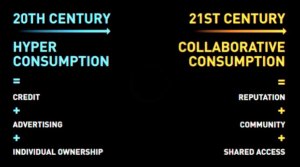
What exactly is the sharing economy?
Well according to a recent Nesta report in to the collaborative/sharing economy the 5 defining traits are:
1. Enabled by internet technologies.
2. Connecting distributed networks of people and/or assets.
3. Making use of the idling capacity of tangible and intangible assets.
4. Encouraging meaningful interactions and trust.
5. Embracing openness, inclusivity and the commons.
It then goes on to define it further in the report by describing the 4 pillars of activity:
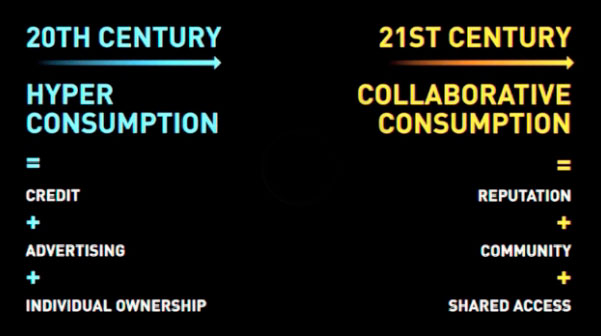
1. Collaborative consumption – gaining access to goods/services through bartering, renting, lending, swapping and so on. Examples of this could be Grub Club.
2. Collaborative production – groups collaborating on design/prodcution. Examples Quirky, Nimber and OpenStreetMap.
3. Collaborative learning – sharing knowledge and resources with learning experiences that are open to anyone. Examples of this are FutureLearn, Skilio and Wikipedia.
4. Collaborative finance – funding, lending and investments outside the traditional financial institutions. Examples Seedrs, Echo, or Zopa.
It’s estimated that within a decade the sharing economy could be worth $335 million globally.
This is not a fad either, this is a complete shift in the way the world is going to operate.
There are three main reasons for me saying that with confidence.
Firstly, the internet/technology is enabling a more efficient way of connecting supply and demand, producers with consumers, which will reap the reward of cutting out a lot of links/middle-men in the chain. Thus making great efficiencies.
Secondly, the dwindling resources coupled with the every increasing demand from the 7 billion and growing people on the planet. This means that sharing and more efficient ways of producing, distributing and consuming goods and services is inevitable and necessary for sustaining the human race.
Lastly, there is a growing generation or community of people who want this and are driving this forward. The connected generation who live in that digital world, who live through their connected online networks. This is growing year on year and these people will be the majority of the working population globally by 2025.
This last reason is the thing that I am most passionate about.
At the age of 47, I have grown up in the 70’s and, most influentially on a whole generation, the 80’s. I grow up through, what will be seen as the worst part of capitalism, where the endless pressure for never ending increases in profit at whatever cost, created a world of selfishness and greed.
We have collectively created that ‘me, me, me’ culture, where we worship at the shrine of possessions, money, profit, bigger, faster and more stuff. The cynical machine has most of us trapped on the hamster wheel of working to maintain that lifestyle.
We live in a world where we are made to feel like a loser if we don’t keep consuming and achieving. Our measure of worthiness is how many friends we have on Facebook.
This is why the sharing economy is so important for the world. It’s not just about efficiencies and technology. What it’s about is people and communities.
The sharing economy is already and will continue to bring people together with a common goal and purpose. That goal is not driven by money and is giving people a chance to belong and become worthy again for being themselves.
The heart has been ripped out of the world and has killed idealism and created cynical greed. What the sharing economy will do is create communities focussed on people.
It is like a beacon of hope on the horizon for all of us, it’s chance to start to unravel the past and a chance to bring equality in to the world. We can start thinking about a human race, which all 7 billion of us belong to. We can start looking at what’s good for all of us, instead of what is good for that top 1%.
So we are at that fork in the road for the human race, one way is clinging on to the old world of ‘ism’ and that broken OS that’s failed or we can be brave and vulnerable and take the other fork.
The other fork allows us to install new software on the world, a new OS that is hard wired to focus on people first and not money.
So if you are not yet involved with the sharing economy, collaboration, then find out about it and get involved for all of our sakes.
 Philip Dodson