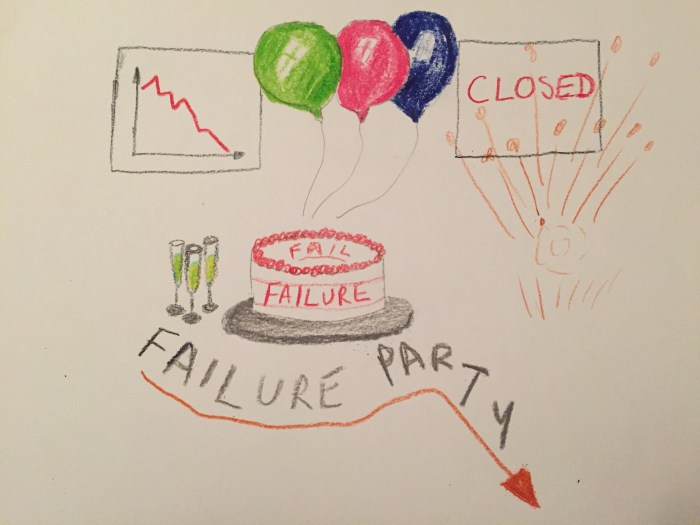
Meetup groups celebrating failure are as common now as groups celebrating success.
We have developed this fake bravado surrounding failure and the glib, celebrity style over trivialisation of failing is doing a lot of harm. It is seen as a cult-like thing to be brave enough to admit to failing.
True bravery is being vulnerable enough to be compassionate to ourselves.
Failure is a subjective thing, and it is a personal thing.
This idea that we should all be ‘macho’ and face up to failing in this immature way is wrong. It is an important part of all of our lives that needs to be handled thoughtfully.
Failure comes with a great deal of often painful emotions for the person who perceives that they have failed. There is no such thing as failure, there is a perception that you have failed. It is, however, an important and vital step to learning and personal advancement that needs to be handled sensitively and at our own pace. Not to be ignored or buried, certainly to be dealt with, but not trivialised like so many emotional things in our world.
We could instead choose a culture that promotes learning from less than desirable outcomes. We could instead promote empathy, compassion and a choice that sees outcomes as a chance to become better, a chance to adjust. It needs to be done in a properly structured a ‘safe’ environment, where people can be open and vulnerable in a non-judgemental, supportive and compassionate environment. Not over a bowl of nachos in a room full of randoms swapping ‘war’ stories to see who can blurt out the biggest fuckup to win the ‘I’m a failure’ rosette.
We could also choose to promote the success that is there in any outcome as nothing is so black or white as to be all a failure and all a success.
It is irresponsible, however, to almost try to bury and trivialise people’s emotions and challenges regarding their own interpretations behind a gloss of fake celebration of not achieving our expectations.
Empathy, learning and seeing the positives from outcomes will always outweigh this and will always build lasting transitions for people to a become a better version of themselves.
No good comes from seeing outcomes as a failure. What is good is to learn from the things that did not go as expected, to be kind to ourselves always and to pat ourselves on the back for what went right.
If you want to have a failure party, go ahead, but realise that you won’t feel better.

 Philip Dodson