To home work or not to?

This is an interesting dilemma for millions of freelancers. There are obvious attractions to working from home when you are a freelancer, especially in the early days of setting up, as costs are often an issue.

Home worker

People see the costs savings of not having to commute, not having to buy lunches, not paying for space and generally the time savings too.

They initially view working from home to be distraction free, especially attractive if you’ve just left the open plan office of your previous paid employment job.

You also feel that you will be happier at home, as you can enjoy a work/life balance, that previously you could only dream of with the ‘7am to 7pm’ life of working for someone else.

However, after a while, what happens is, you realise that you get increasingly lonely working at home, you start to crave those ‘distractions’ of others. You come to the conclusion that some of those distractions were in fact valuable interactions.

You miss the knowledge sharing, the boost to morale of having someone to share things with, especially important when things are going less well. After all, we are all going to have crap days.

The next thing, you find is that the motivation starts to drop, as you ease into a blurred work/life environment. There are often distractions in an office, but there are different ones at home.

Like partners, children, pets, Jeremy Kyle, Playstation (maybe this just me), shops, washing to hang out, dinner to put on, ironing etc etc. OK, so we will have varying degrees of self-discipline, but you will get distracted.

Cabin fever sets in and that’s when it is time to get out the house and seek people. Although often people think that the solution is to head to a coffee shop.

The challenge with working in a coffee shop is that they are noisy and the wrong sort of nosiy – music, kids etc. Then typically the Wi-Fi is poor, you feel guilty that you haven’t bought a coffee for at least an hour, there is still no chance of any meaningful conversation and of course you will have to take your laptop to the toilet. When you come back your seat will be gone.

Until more recently the next option was very often a serviced office, which for most freelancers was a cost and commitment too far.

Now there are options – coworking spaces have sprung up all over world and are opening at a rapid rate as the rise globally in self-employment continues to grow off the charts.

What coworking offers, if you find the right one, is a flexible workspace, so you can still enjoy the good elements of home working. It will provide you with a community, something to belong to and that for me is the biggest benefit of coworking over full time home working.

As a freelancer, who has left the world of paid employment for the freedom of self-employment, you have closed the door on your support system, the community of colleagues and that leaves you on your own, no longer belonging.

What coworking provides is others to share ideas, share knowledge, help you and to do business with. It is the serendipity of those chance meetings, that will lead eventually to opportunity to grow your business, that you will never get being at home.

The other advantages of coworking spaces is they often run workshops, events, business networking groups. They can provide you access to mastermind groups and mentoring. So a chance to grow your network beyond the coworking space regulars and get invaluable advice for you and your business.

At the end of the day businesses, especially solo-preneurs, are all better of working and collaborating with others than they are trying to ‘row their own boat’.

Human beings are designed to be social and to work together and not be on their own.

This is what is critical in coworking – collaboration. Your products/service etc will be greatly enhanced by working with others. You will also increase your reach and customer base by sharing and working with others.

So the answer to the question ‘To home work or not to?’ is – not to home work all day every day, as you risk isolation and missing opportunities to grow you and your business.
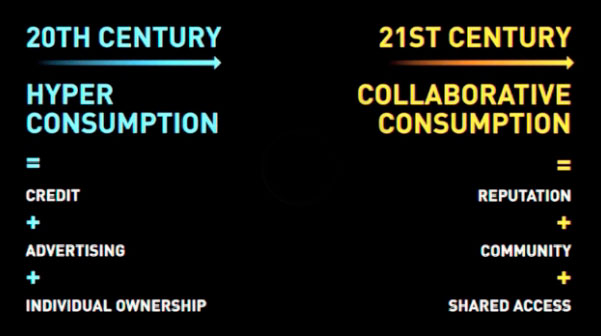
Why is the sharing economy so important?

Why is the sharing economy so important? 76% of people in UK have not even heard of it.

Sharing Economy

What exactly is the sharing economy?

Well according to a recent Nesta report in to the collaborative/sharing economy the 5 defining traits are:

1. Enabled by internet technologies.
2. Connecting distributed networks of people and/or assets.
3. Making use of the idling capacity of tangible and intangible assets.
4. Encouraging meaningful interactions and trust.
5. Embracing openness, inclusivity and the commons.

It then goes on to define it further in the report by describing the 4 pillars of activity:

1. Collaborative consumption – gaining access to goods/services through bartering, renting, lending, swapping and so on. Examples of this could be Grub Club.

2. Collaborative production – groups collaborating on design/prodcution. Examples Quirky, Nimber and OpenStreetMap.

3. Collaborative learning – sharing knowledge and resources with learning experiences that are open to anyone. Examples of this are FutureLearn, Skilio and Wikipedia.

4. Collaborative finance – funding, lending and investments outside the traditional financial institutions. Examples Seedrs, Echo, or Zopa.

It’s estimated that within a decade the sharing economy could be worth $335 million globally.

This is not a fad either, this is a complete shift in the way the world is going to operate.

There are three main reasons for me saying that with confidence.

Firstly, the internet/technology is enabling a more efficient way of connecting supply and demand, producers with consumers, which will reap the reward of cutting out a lot of links/middle-men in the chain. Thus making great efficiencies.

Secondly, the dwindling resources coupled with the every increasing demand from the 7 billion and growing people on the planet. This means that sharing and more efficient ways of producing, distributing and consuming goods and services is inevitable and necessary for sustaining the human race.

Lastly, there is a growing generation or community of people who want this and are driving this forward. The connected generation who live in that digital world, who live through their connected online networks. This is growing year on year and these people will be the majority of the working population globally by 2025.

This last reason is the thing that I am most passionate about.

At the age of 47, I have grown up in the 70’s and, most influentially on a whole generation, the 80’s. I grow up through, what will be seen as the worst part of capitalism, where the endless pressure for never ending increases in profit at whatever cost, created a world of selfishness and greed.

We have collectively created that ‘me, me, me’ culture, where we worship at the shrine of possessions, money, profit, bigger, faster and more stuff. The cynical machine has most of us trapped on the hamster wheel of working to maintain that lifestyle.

We live in a world where we are made to feel like a loser if we don’t keep consuming and achieving. Our measure of worthiness is how many friends we have on Facebook.

This is why the sharing economy is so important for the world. It’s not just about efficiencies and technology. What it’s about is people and communities.

The sharing economy is already and will continue to bring people together with a common goal and purpose. That goal is not driven by money and is giving people a chance to belong and become worthy again for being themselves.

The heart has been ripped out of the world and has killed idealism and created cynical greed. What the sharing economy will do is create communities focussed on people.

It is like a beacon of hope on the horizon for all of us, it’s chance to start to unravel the past and a chance to bring equality in to the world. We can start thinking about a human race, which all 7 billion of us belong to. We can start looking at what’s good for all of us, instead of what is good for that top 1%.

So we are at that fork in the road for the human race, one way is clinging on to the old world of ‘ism’ and that broken OS that’s failed or we can be brave and vulnerable and take the other fork.

The other fork allows us to install new software on the world, a new OS that is hard wired to focus on people first and not money.

So if you are not yet involved with the sharing economy, collaboration, then find out about it and get involved for all of our sakes.